
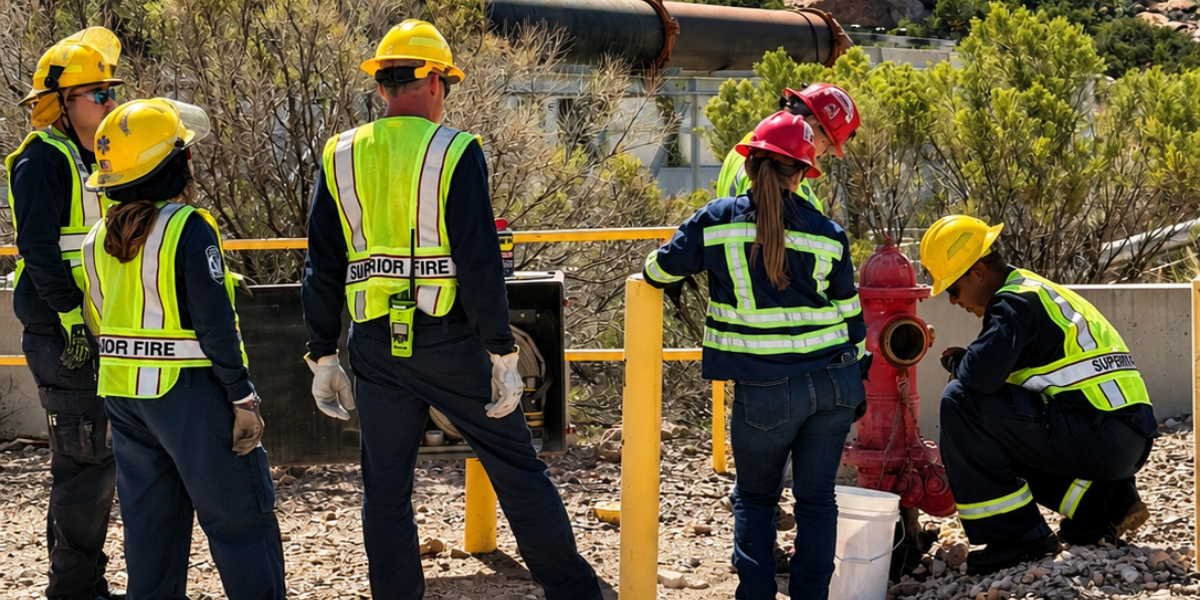
Meet Resolution Copper’s Mine Rescue Team
Dozens of volunteers. Twelve days of training a year. All on top of their regular jobs.
Most days, they’re working underground, maintaining equipment, managing teams and projects, studying rock formations, welding, turning wrenches or handling any number of jobs that keep things running at Resolution Copper.
But some of our employees also volunteer for mine rescue. It’s an extra responsibility that comes with specialized training, long days of practice and the possibility of being called on to help a fellow miner in an emergency.
It’s a job they train hard for and hope they never have to do.
One team. One important responsibility.
Our mine rescue team brings together people from all over the operation. Electricians, welders, shaft technicians, mechanics, hoist control operators, underground miners, maintenance professionals, geologists, supervisors and many others. They all have their regular jobs, but they’ve also volunteered to take on the extra training and responsibility that comes with mine rescue.
To join the team, volunteers need at least one year of underground experience. From there, the training continues year-round. And there’s plenty to learn.
One full day of training. Every month.
Our mine rescue volunteers set aside one full day each month to practice responding to underground emergencies.
That adds up to 12 days a year spent working through rescue scenarios, learning new techniques and getting comfortable with the equipment they may need in an emergency.
Training focuses on five areas:
- Firefighting: Responding to fires and the hazards that come with them.
- Rope rescue: Using ropes and specialized equipment to reach and recover people in difficult locations.
- Medical response: Practicing first aid, CPR, trauma care and other emergency medical skills.
- Hazardous atmospheres: Learning to work around dangerous gases, smoke and limited visibility.
- Search and recovery: Navigating underground areas, locating people and practicing recovery procedures.
Some training days involve ropes, knots and rescue equipment. Others focus on medical emergencies, confined spaces or finding their way through smoke. There’s a lot of hands-on practice, often in simulated conditions that make the work more challenging.
For Chris Villaverde, Resolution Copper’s Mine Rescue Team Captain and on of our Hoist Control Operators, that training is something he takes seriously.
“Nobody ever wants to get the call that something has gone wrong underground. But if that call comes, I want to be one of the people ready to respond and make a difference. As a Team Captain, my priority is the continued development of our team through consistent, hands-on training and preparing for worst-case scenarios.”
Chris says the time volunteers put into training is what gives him confidence in the team. “In mine rescue, there is no substitute for training, teamwork, and being ready when it matters most. My hat goes off to every team member who continues to dedicate countless hours to training and improving their skills. That commitment is what makes us stronger as a team.”
The team also has to learn how to work together. In an emergency, each person needs to know their role, understand the equipment and be able to count on the people working alongside them. That’s why they practice together every month.
The people in the red hard hats
If you’ve spent time around our operation, you may have noticed the red hard hats worn by our mine rescue volunteers.
Under those hard hats are people with very different day jobs. An underground geologist might train alongside an electrician. A welder might work through a rescue exercise with a shaft technician or maintenance specialist.
AJ Quiroz, Resolution Copper’s Mine Operations Superintendent and a mine rescue volunteer, has seen plenty of changes during his 19 years with the company. But the importance of relying on the people around you hasn’t changed.
“I’ve been here 19 years, and a lot has changed underground. But one thing that hasn’t changed is how much we count on each other. That’s what I like about our mine rescue team. These guys already have their regular jobs, but they still put in the extra time to train so they’re ready if someone needs help.”
For Rudy Hill, Resolution Copper HSE Generalist Advisor and longtime mine rescue volunteer and team lead, those relationships have grown over years of working and training together.
“I spend more time with some of these guys than I do with my own family. After working and training together for so many years, they’ve become like family to me. That’s a big part of why I keep volunteering for mine rescue.”
For Freddie Martinez, an Environmental Technician at Resolution Copper and mine rescue volunteer, that connection goes beyond the mine. Growing up in Superior, he’s seen firsthand how closely mining and the community are connected.
“At the end of the day, these are people I work with, live around, and care about. In a small town like Superior, we all know each other, and mining has always been a big part of the community. Being on the mine rescue team gives me a chance to give back and be there for the people around me. It’s a great feeling knowing the skills we’re learning could make a real difference when it matters most.”
Why we recognize Mine Rescue Day
October 30 is Mine Rescue Day, a national observance established in 2013 to recognize the men and women who train to respond to mine emergencies.
There are more than 250 certified, trained and equipped mine rescue teams across the United States. Federal mine safety regulations require underground mines to have access to trained and equipped mine rescue teams. It’s an important part of emergency preparedness in the mining industry.
At Resolution Copper, our volunteers help us meet that responsibility while continuing to do their regular jobs across the operation.
Hats off to our volunteers
We hope our mine rescue team never has to put its training to use in a real emergency. But we’re glad they’re prepared.
As Chris puts it, “Hopefully, we never have to put that training to the test. But if the call comes, I’m confident we’ll be ready to answer it.”
To all of our volunteers, thank you for the extra hours, the hard work and the commitment you’ve made to your fellow miners.
And if you see someone wearing one of those red hard hats around site, take a minute to thank them. They’ve earned it.