
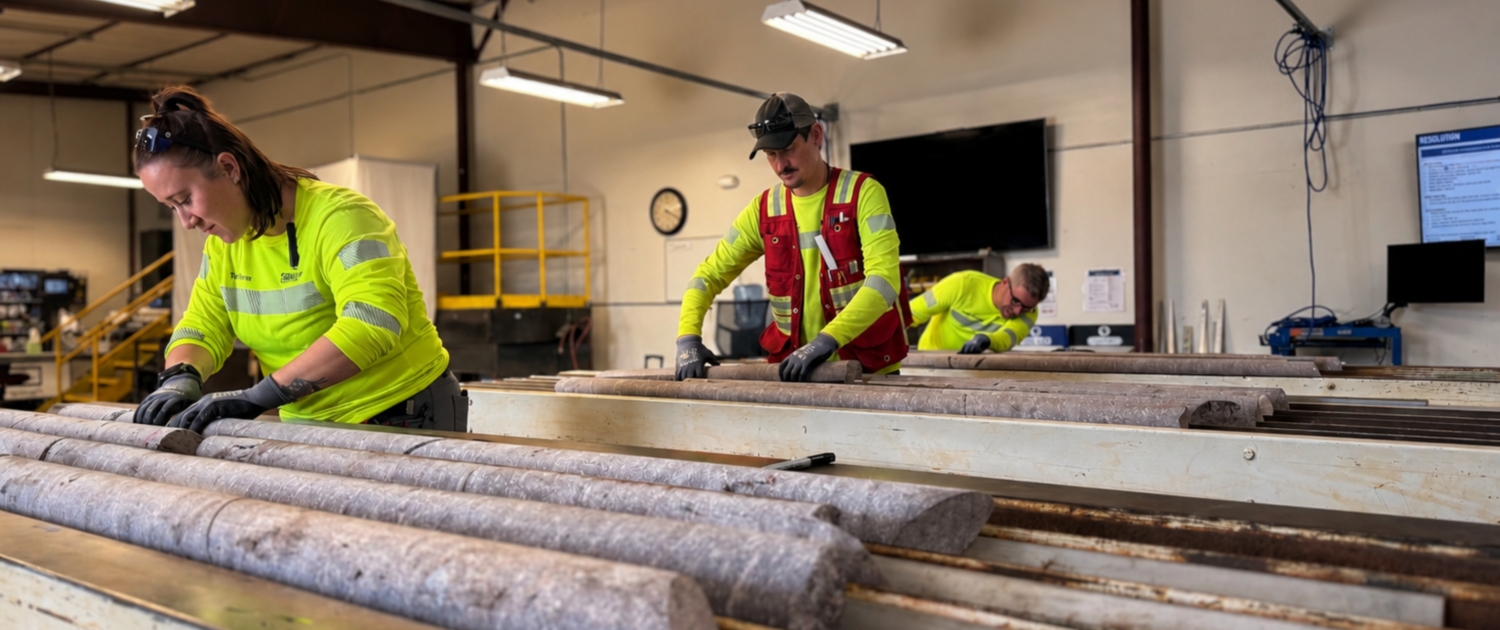
Meet the People Behind the Core
There are jobs where you work with spreadsheets. Jobs where you work with heavy equipment. And then there are jobs where working with rocks is literally part of the assignment.
Welcome to the Core Processing Facility.
As drilling continues at Resolution Copper, drilling crews are bringing up pieces of rock called drill core. Those pieces give our geology and resource teams information about what lies underground.
But the core doesn’t magically turn itself into useful information. That’s where our core handlers, geo-technicians and geologists come in.
First stop: the core handlers
Matt, Mario, Jordan, Anthony, Carrington, Daryll and Wade are among our newest core handlers. Their work starts by picking up core from drilling sites and bringing it to the Core Processing Facility.
From there, there is plenty to do.
Core is unloaded, organized, washed, measured and labeled. Samples need to stay in the correct sequence so geologists know where each piece came from and can accurately record information such as sample depth and core recovery.
That location matters. Keeping the core in order helps our teams piece together a more complete understanding of the ore body and surrounding geology. Old and new core also needs to be properly stored and organized.
In other words, there are a lot of rocks, and every one has a place. That attention to detail matters because each section of core provides another piece of information about the geology beneath us. Think of it as putting together a very large, very rocky puzzle.
Then we take a closer look
Once the core is prepared, technology helps us take an even closer look.
That’s where our geo-technicians come in.
One of the tools they use is called a Point Load Test. The concept is surprisingly straightforward.
A small piece of rock is placed between two steel cones, pressure is applied until the rock breaks. Yes, sometimes science involves carefully documenting a rock and then crushing it. The test provides information about rock strength that engineers can use as they study and plan future development.
Core can also be scanned to create a detailed digital record. Our Core Scanner photographs and digitizes geological core, giving technical teams another way to document, review and study the samples. The specialized system combines high-resolution digital photography with sensors that can capture additional information about the core. So those rows of rock aren’t only stored in boxes. They can also become detailed digital records our technical teams can return to and study.
Thomas, Rudy and Jeanine are among our newer geo-technicians. They help geologists and mining engineers collect, test and document information about rock and other earth materials. Their work includes preparing samples, operating testing equipment, recording information and helping compile technical data. Piece by piece, those observations, images, measurements and test results add to what we know about the rock underground.
One piece at a time
No single piece of drill core tells the whole story.
Put thousands of observations, measurements and test results together, however, and a much clearer picture begins to emerge.
That information helps geologists, engineers and other technical teams better understand the ore body and surrounding rock as planning and development work continues.
And the jobs themselves can open doors.
Core handling can be an entry point for people interested in mining and earth sciences. Over the years, some Resolution Copper employees who started as core handlers have gone on to work as electricians and mechanics and on our underground mining teams.
So the next time you see a box filled with what looks like a bunch of cool rocks, take another look. There’s a lot of information hiding inside. And there are a lot of people behind the scenes making sure we learn from it.
Meet the people helping us put the pieces together.
KEEP DIGGING 👇
Geologist’s Perspective: The Resolution Ore Body
See how our geology team turns information from the rock into a better understanding of the deposit.
The Descent – What It’s Like Traveling Nearly 7,000 Ft. Underground
Take the trip underground and see where some of this work is happening.
Inside Our Underground Concrete Work on 68L
Go underground with the crews preparing infrastructure for the next phase of development.